Version 0.2.0-draft
The missing protocol surface is not tools or agents. It is accountability.
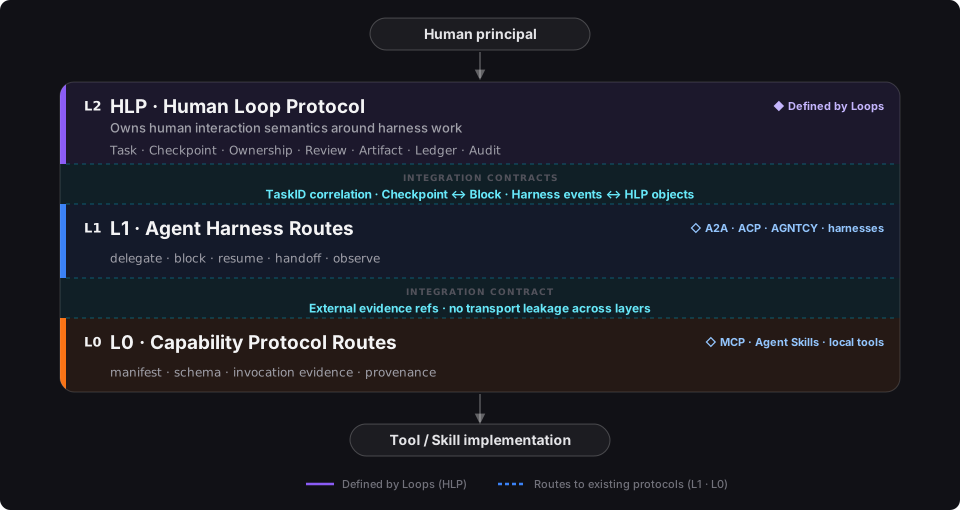
HLP defines how a human principal delegates bounded work to autonomous agent harnesses, pauses execution for decisions, reviews artifacts, and replays the entire lifecycle through audit.
DefinesTask ownership, checkpoints, reviews, artifacts, ledger, audit
Routes toExisting harnesses, A2A, ACP, AGNTCY, MCP, Agent Skills, local tools
Does not replaceAgent harnesses, tool protocols, transports, RBAC, UI channels
SDK surface
Applications embed HLP as an SDK, not as an execution harness.
Public entry pointloops and loops.hlp expose HLP protocol objects, HLPClient, HLPHost, stores, events, and adapters.
Runtime boundaryAgentAdapter controls external harnesses; HarnessAdapter projects their human-facing events into HLP.
SDK boundaryLoops does not ship a built-in agent harness. Execution belongs to the harness you wrap.
from loops import ArtifactPayload, CheckpointOptionfrom loops import CodexCLIAdapter, HLPHosthost = HLPHost.in_memory(adapter=CodexCLIAdapter())client = host.clienttask = await client.create_task( principal="user_alice", goal="Review PR #1234",)run = await client.delegate(task.id, "agent_codex")await client.start(task.id)checkpoint = await client.raise_checkpoint( task_id=task.id, kind="choice", prompt="Ship the patch?", options=(CheckpointOption(id="safe", label="Review first"),), raised_by=run.agent_id,)await client.resolve_checkpoint( checkpoint.id, by="user_alice", action="choose", choice="safe")artifact = await client.commit_artifact( task_id=task.id, type="report", payload=ArtifactPayload( kind="inline", uri="mem://report-v1", checksum="sha256:report-v1" ), produced_by=run.agent_id,)review = await client.submit_review( task_id=task.id, artifact_id=artifact.id, reviewer="user_alice", verdict="approved",)await client.write_ledger("project:web", "pr.1234", review.verdict, by=task.id)audit = await client.replay_audit(task.id)
First-class adapters
Four agent CLIs share one harness projection pipeline.
Codex, Pi, Claude Code, and Kimi wrap into HLP with the same JSONL projection of human-loop events, reliable peek/ack event delivery, and chat/protocol prompt modes — covered by offline contract suites and an opt-in live four-CLI lifecycle E2E.
| CLI | Delegate adapter | Harness adapter (projection + peek/ack) | Wire mode |
|---|
| Codex | CodexCLIAdapter | CodexHarnessAdapter | codex exec --json |
| Pi | — | PiHarnessAdapter | pi --mode json |
| Claude Code | ClaudeCodeCLIAdapter | ClaudeCodeHarnessAdapter | claude -p --output-format stream-json |
| Kimi | KimiCLIAdapter | KimiHarnessAdapter | kimi -p --output-format stream-json |
Sensor input such as brain-computer interfaces (BCI) is compatible by design (spec appendix C): a decoder is only a channel-plane producer of ControlSignal values, high-risk checkpoints cannot close on BCI alone (fail-closed, second factor supported), and the offline loops-hlp-bci-demo proves it — zero protocol changes.