
Overview
Human Loop Protocol
HLP defines accountability around autonomous harness work.
A human principal delegates a bounded task to an existing agent harness, the harness raises decision checkpoints, humans review artifacts, and the full lifecycle remains replayable.
HLP sits above existing agent harness and capability ecosystems. Those lower layers are integration routes, not new protocols owned by Loops:
| Layer | Role in this project | Concern | Typical implementation |
|---|---|---|---|
| L2 | HLP specification and SDK | Human-loop work | Task and review platforms |
| L1 | Agent protocol route | Agent delegation and run lifecycle | Existing harnesses, A2A runtimes, ACP brokers, agent meshes |
| L0 | Capability protocol route | Tool, skill, and capability invocation | MCP servers, Agent Skills runtimes, local tools |
The central claim is simple: a platform should be able to wrap a new agent harness without rewriting human review semantics, change a capability provider without changing task governance, and add a new UI channel without changing execution rules.
Problem
Most agent products are vertical stacks. Provider calls, tools, channels, human approvals, artifact delivery, and audit logic live in one harness-specific code path. That works while the product is small. It becomes brittle when each concern evolves at a different speed.
Models change weekly. Communication channels change quarterly. Governance, identity, audit, and review processes change slowly and must remain reliable. A single harness abstraction cannot carry all three rhythms without coupling them.
Model
HLP treats the human loop as the stable top-level protocol and routes downward through adapter contracts:
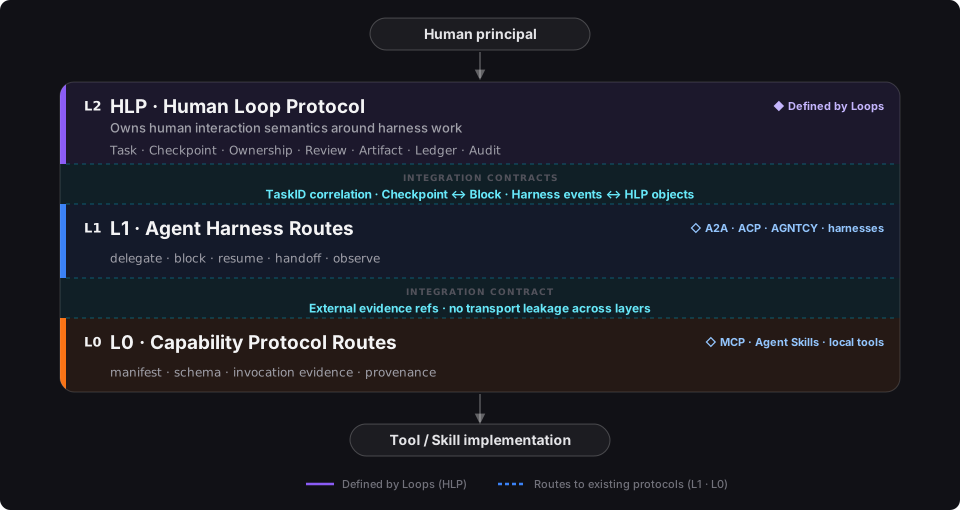
The ASCII view below traces the operations that flow down through the stack:
Human principal
  │
  │ HLP: task.assign, checkpoint.raise, review.submit, audit.replay
  ▼
Existing agent harness
  │
  │ L1 route: delegate, block, resume, handoff, harness events
  ▼
Capability source
  │
  │ L0 capability route: manifest, provenance, invocation evidence
  ▼
Tool or Skill implementation
The boundaries are deliberately narrow:
- HLP defines the lifecycle of human-owned work: tasks, checkpoints, ownership, reviews, artifacts, ledgers, and audit events.
- L1 agent routes point to existing harnesses and agent protocols. HLP only needs delegation, blocking, resuming, handoff, and human-facing harness events.
- L0 capability routes point to existing capability protocols. HLP only stores opaque external evidence when a human decision or audit trail needs capability context.
Design Principles
One layer, one responsibility
HLP owns accountable work. Existing agent harnesses own execution and delegation. Existing capability systems own tool and skill invocation. HLP observes those systems through explicit adapter contracts; it does not absorb their protocols.
Dependencies flow downward
The allowed dependency direction is:
HLP (L2) -> agent protocol route (L1) -> capability protocol route (L0)Capability implementations never need to know HLP exists. Agent harnesses only see HLP through correlation, block/resume, and event projection contracts. HLP never calls a tool directly.
Cross-layer communication uses contract objects
Layers do not read or mutate each other's internal state. They coordinate through explicit objects:
| Contract | Purpose |
|---|---|
ExternalRef | Lets HLP record opaque external evidence without seeing transport or invocation details. |
TaskID = Run.correlation_id | Carries HLP task identity through every agent run and event. |
Checkpoint -> block/resume | Maps a human decision point to an agent run pause and restart. |
HarnessEvent -> HLP object | Projects approval, input, choice, and artifact events into HLP semantics. |
Ownership -> handoff | Maps task ownership transfer to agent handoff while preserving correlation. |
Forward-only state
HLP is designed for replayability and audit. Task specs, artifact versions, reviews, ledger entries, and audit events are immutable. Corrections are modeled as new entries or new versions, not as destructive edits.
What Loops Defines
This project defines:
- A complete HLP 0.2.0-draft protocol for accountable human-loop work.
- A Python SDK with protocol objects,
HLPClient,HLPHost, stores, event bus, and adapters. - Integration contracts for routing HLP task identity, checkpoints, ownership, harness events, and optional external evidence into existing agent and capability protocols.
- First-class harness adapters for the Codex, Pi, Claude Code, and Kimi CLIs — one shared JSONL projection pipeline with reliable peek/ack event delivery and per-event correlation validation.
- An appendix-C channel model for high-frequency and sensor input: soft control signals merge on the host and promote into existing responsibility operations, so channels such as voice or brain-computer interfaces (BCI) stay compatible without protocol changes (high-risk checkpoints still cannot close on BCI alone).
- Introductory L1/L0 route pages that explain where A2A, ACP, AGNTCY-style meshes, MCP, Agent Skills, and local capability systems fit.
- HLP conformance requirements that let implementations make precise claims.
This project does not define:
- A built-in agent harness or execution loop.
- A replacement for A2A, ACP, AGNTCY, MCP, Agent Skills, or harness internals.
- A mandatory transport such as HTTP, gRPC, WebSocket, or stdio.
- A required persistence backend.
- A universal identity, RBAC, or billing model.
- A UI specification for chat, web, IM, or CLI experiences.
Why HLP Is New
MCP and Skills cover agent-to-capability calls. A2A and related protocols cover agent-to-agent delegation. The missing protocol surface is the one that connects autonomous agents back to the people responsible for the work.
HLP fills that gap with seven first-class objects:
| Object | Role |
|---|---|
| Task | A bounded unit of work owned by a human principal. |
| Checkpoint | A decision point raised by an agent and resolved by a human. |
| Ownership | The transferable assignee record for the task. |
| Review | Human feedback on an artifact. |
| Artifact | An immutable deliverable with provenance and versions. |
| Ledger | Append-only project or organization state. |
| Audit | Immutable protocol operation log. |
Together, these objects make human-loop work inspectable, replayable, and implementable across harnesses.
Specification Status
All protocol documents are currently 0.2.0-draft. Draft status means the semantic model is concrete enough to implement, but transport bindings and some open policy choices remain intentionally outside the core specification.
Start with the Implementation Guide, then use Conformance to decide what your implementation can claim.